Can nature trace its own path?
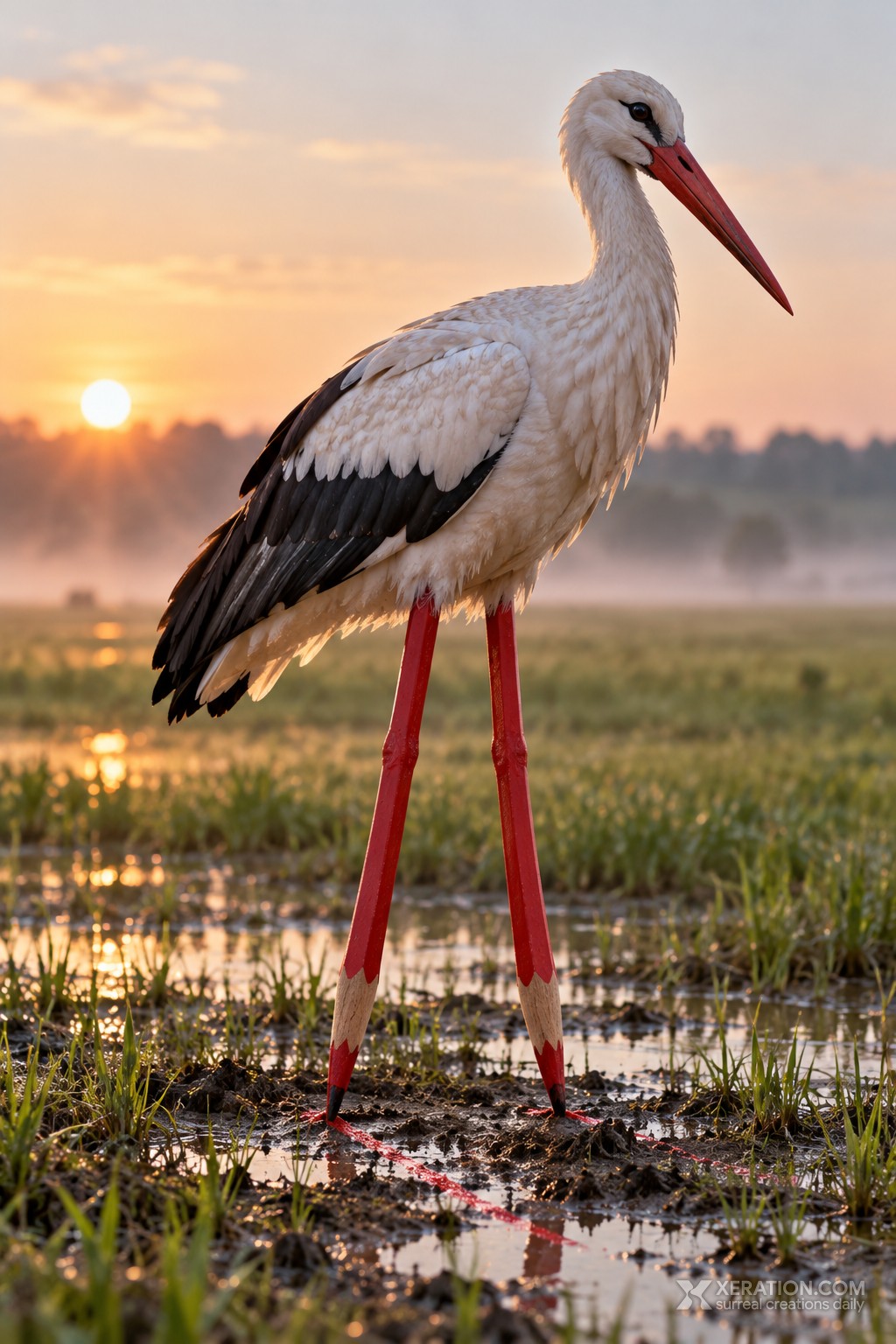
A white stork stands in a misty wetland at dawn with sharpened red colored pencils seamlessly replacing its long legs.
What you see
The photograph shows a white stork standing alert in a misty wet meadow at sunrise. Instead of biological wading limbs, its long lower legs transition seamlessly into sharpened red colored pencils. The fine red tips sink slightly into the soft ground, leaving delicate crimson marks across the damp soil.
A white stork and a red colored pencil are fused along their shared geometry as slender vertical cylinders. The bird's organic stilts merge with the rigid, mass-manufactured drafting tools without disrupting the creature's familiar silhouette.
Wild nature collides with geometric artificiality. The stork represents instinctive survival and untamed wetlands, while the colored pencil stands for deliberate human calculation, drafting, and synthetic pigments. This physical fusion turns an untamed bird into an unwitting drawing instrument, scoring mechanical lines across a wild morning landscape.
Can I use this?
Yes, for anything, free of charge. In return we'd be grateful for a little publicity: a post or a link, or at least telling a friend about XERATION.